
Yellow Iris
Description
Yellow iris (Iris pseudacorus) is an invasive aquatic plant native to Eurasia and North Africa that was introduced to North America as an ornamental plant. Known for its showy yellow flowers, it grows along shorelines and in wetlands, ponds, streams, and other wet habitats. Yellow iris spreads through both seeds and underground stems called rhizomes, allowing it to form dense patches that crowd out native vegetation, reduce biodiversity, and alter wetland habitats. Despite its invasive impacts, yellow iris is still widely available through the horticultural industry.
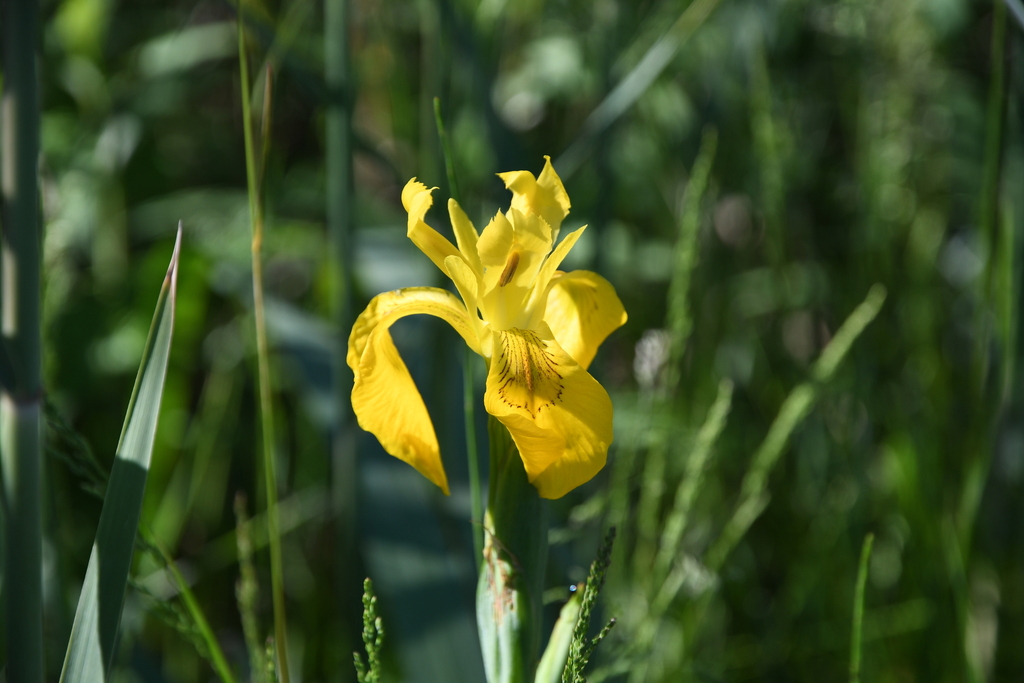
© fboue19 via iNaturalist.org, used under CC-BY-NC
Introduction and Spread
Yellow iris was brought to North America as an ornamental plant and is still widely available in the horticulture industry. It was first recorded in North America in Newfoundland in 1991 (Tu 2003; Denslow et al. 2010; Jacobs 2010). Yellow iris can spread via rhizomes and seeds that can float for extended periods of time, facilitating their spread via water (Sutherland 1990; DiTomaso and Kyser 2016). Several hundred plants can be connected via rhizomes (Morgan et al. 2025), and fragments as small as 2 cm can generate new plants (Jaca 2013). However, most infestations originate from the intentional planting of yellow iris in gardens, which then spread to nearby natural areas such as wetlands, rivers, streams and shorelines. It may also be unintentionally transported on contaminated equipment such as seeds or rhizome fragments on boots or spades/shovels used for manual removal.
Yellow iris is native to Eurasia and North Africa (Tu 2003). In North America, it is found in all states, with the exception of North Dakota and Arizona (EDDMapS 2025). Yellow iris is widespread across Canada and occurs in every province and territory except for Saskatchewan, Manitoba, Yukon, Nunavut and the Northwest Territories. It is listed as noxious weed in British Columbia and Alberta.
Habitat
Yellow iris grows in or near water, although, it can survive in wet terrestrial environments. This includes in and around streams, rivers, ponds, wet meadows and wetlands. It is also found in disturbed environments such as roadside ditches and stormwater management ponds. It prefers full sun and soils that have high moisture content. It can tolerate salinity, low-fertility soils including those with poor oxygen availability (Tu 2003; Jacobs et al. 2010).
Identification
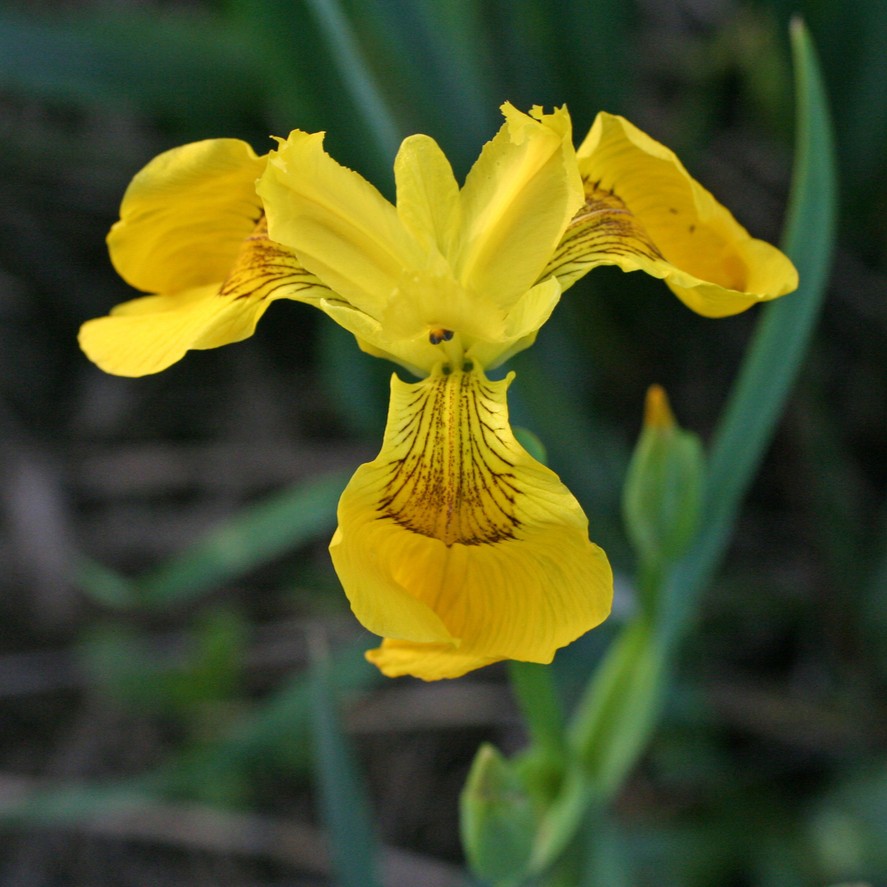
Yellow iris flower
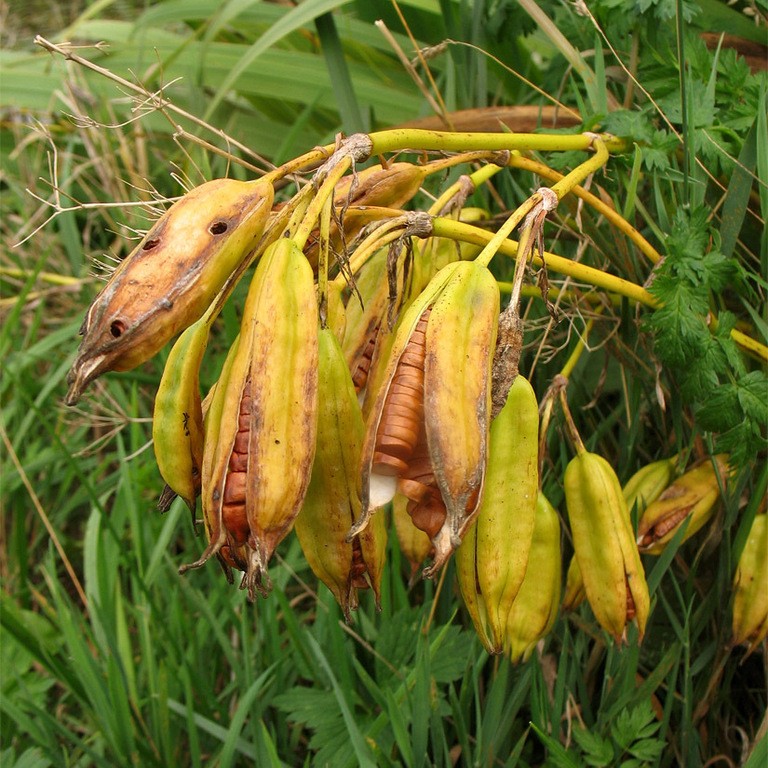
Yellow iris fruit
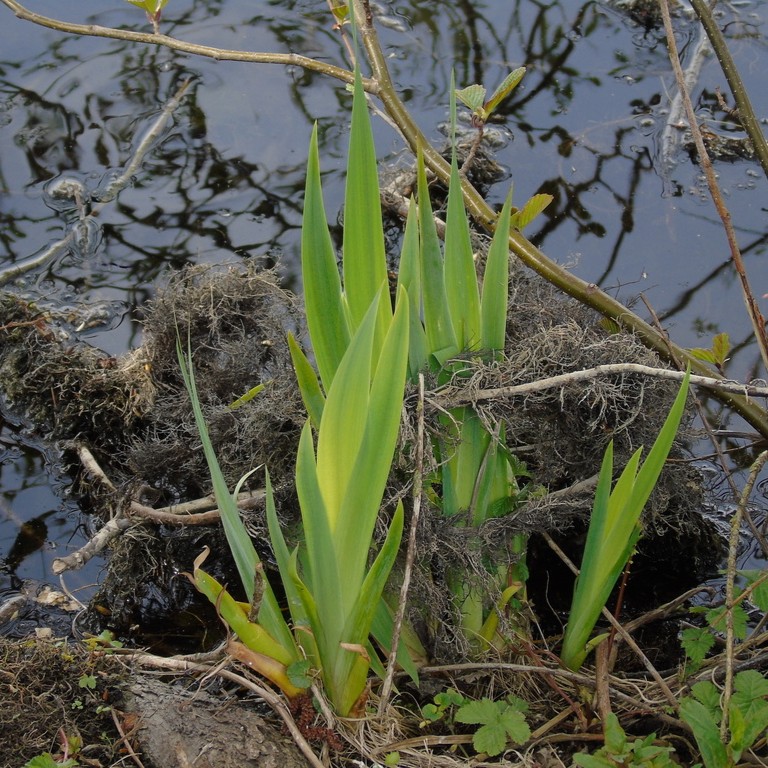
Yellow iris leaves
Impacts
Life cycle
The leaves of yellow iris emerge in early spring and actively grow from April to June. This typically occurs via its rhizomes that remain dormant over the winter, rather than from new seeds. It reaches sexual maturity at three years old. Flowering occurs between May and June and flowers are pollinated by bumblebees and long-tongued flies (Tu 2003; Morgan et al. 2025). Fruits that contain between 32 – 120 seeds ripen and disperse in late summer to early fall. Only a small portion of seeds (up to 20%) are viable (Sutherland 1990; Tu 2003; Gaskin et al. 2016). In the fall, above ground vegetation dies and the plant overwinters via its rhizomes.
What You Can Do
You can help prevent the spread of yellow iris by:
Other Resources
- Denslow, M.W., Katz, G. and Jennings, W.F. 2011. First records of Iris pseudacorus (Iridaceae) from Colorado. Journal of the Botanical Research Institute of Texas. 5(1): 327-329. https://www.jstor.org/stable/41972524.
- DiTomaso, J. and Kyser, G. 2016. Shoreline drizzle applications for the control of incipient patches of yellow iris (Iris pseudacorus). Invasive Plant Science and Management. 9: 205-213. https://doi.org/10.1614/IPSM-D-16-00023.1.
- EDDMapS. 2025. Pale yellow iris, yellow flag iris (Iris pseudacorus L.). [Accessed 2025 March 25] https://www.eddmaps.org/distribution/usstate.cfm?sub=5853/.
- Gallego-Tevar, B., Grewall, B.J., Whitcraft, C.R., Futrell, J.C., Barcenas-Moreno, G. and Castillo, J.M. 2022. Contrasted impacts of yellow iris (Iris pseudacorus) on plant diversity in tidal wetlands within its native and invaded distribution ranges. Diversity. 14: 326. http://dx.doi.org/10.1016/S2095-3119(17)61831-8.
- Gaskin, J.F., Pokorny, M.L., and Mangold, J.M. 2016. An unusual case of seed dispersal in an invasive aquatic; yellow iris (Iris pseudacorus). Biological Invasions. 18: 2067-2075. https://link.springer.com/article/10.1007/s10530-016-1151-0
- Jaca, T. 2013. Iris pseudacorus L.: An ornamental aquatic with invasive potential in South Africa. South Africa Journal of Botany. 86: 174. http://dx.doi.org/10.1016/j.sajb.2013.02.133.
- Jacobs, J, Graves, M and Mangold, J. 2010. Ecology and management of yellow flag (Iris pseudacorus L.). United States Department of Agriculture, Natural Resources Conservation Services. Invasive Species Technical Note No. MT-28. https://citeseerx.ist.psu.edu/document?repid=rep1&type=pdf&doi=106369cd1aa0425afb6afef877876dfa1ed183c2
- Morgan, V.H., Berent, L., and Fusaro, A. 2025. Iris pseudacorus L.: U.S. Geological Survey, Nonindigenous Aquatic Species Database. [Accessed 2025 March 24]. https://nas.er.usgs.gov/queries/greatlakes/FactSheet.aspx?Species_ID=1115
- Sutherland, W.J. 1990. Iris pseudacorus L. Journal of Ecology. 78(3): 833-848. https://doi.org/10.2307/2260902.
- Tarasoff, C., Streichert, K., Gardner, W., Heise, B., Church, J. and Pypker, T. 2016. Assessing benthic barriers versus aggressive cutting as effective yellow iris (Iris pseudacorus L.) control mechanisms. Invasive Plant Science and Management. 9(3): 229-234
- Tu, M. 2003. Element Stewardship Abstract for Iris pseudacorus L. The Nature Conservancy; [Accessed 2025 March 24]. https://www.invasive.org/gist/esadocs/documnts/irispse.pdf.