
Invasive Wild Pigs
Description
Wild Pigs are defined as any animal of the species Sus scrofa that is not contained and able to roam freely (this includes domestic pigs, European wild boar and their hybrids). As a result, wild pigs can have a range of appearances 1, 2. Their coats range from dark to light in colour, and they could have either long snouts like wild boar, or a shorter, “pushed-in” nose like domestic pigs.3 Wild pigs may have a mane of hair that stands on end along their backs and may have prominent tusks. Wild pigs can grow quite large, with adult males weighing up to 100 kilograms.4 Piglets are usually lighter in colour and may be spotted or striped.
Aside from being one of the most widely distributed species, found on all continents except Antarctica, they are also one of the most prolific (i.e., they produce lots of piglets).1, 5
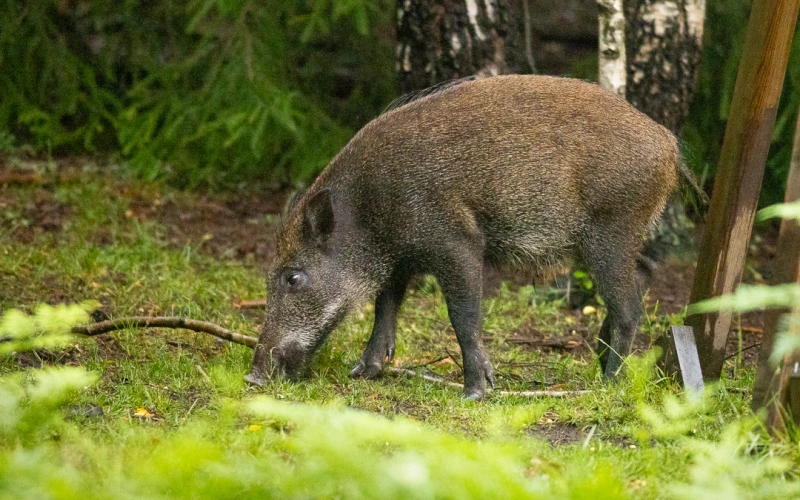
© Tobias R. Radmer via iNaturalist.org, used under CC BY NC
Introduction and Spread
Wild pigs were first introduced to North America in the United States in the 1500s as a livestock species for early explorers and settlers. Today, wild pig populations are found in most states, with particularly high densities in Texas, Florida, and California.6
In Canada, Eurasian wild boar were introduced in the 1980s for farmed meat production and shooting operations.2 At its peak, wild boar farming in Canada consisted of 200 producers who kept approximately 36,000 animals.4 Demand for wild boar was never as strong as anticipated, and the lack of a stable market in the 1990s led some producers to release their livestock into the wild intentionally.1 Today, the number of farmed wild boar is drastically reduced; however, escapes and releases continue to occur.7,8 Once in the wild, wild boar and escaped domestic pigs can breed together and create hybrid offspring.
Distribution
The range and population size of wild pigs have expanded rapidly in recent years.1,4 While occasional sightings are reported in Ontario and Québec, wild pigs are primarily found in the prairie provinces of Alberta, Manitoba, and especially Saskatchewan.1,4 However, since many areas of Canada contain suitable food and habitat, their range and numbers are anticipated to continue growing in the coming years. Within the next fifty years, if left unchecked, the number of wild pigs in Saskatchewan may exceed the province’s human population!9
Impacts
Invasive wild pigs have negative environmental, economic, and health impacts.
Environmental
Wild pig activities like rooting, trampling, wallowing, and eating, can have devastating impacts on the landscape, completely altering ecosystem processes and nutrient cycles.1,7,10 They candecrease biodiversity through competition for food and habitat, and through predation of eggs and young or small animals (e.g., birds, turtles, salamanders, frogs, crabs, snakes). In cases documented internationally, wild pigs are associated with species extirpations and extinctions. Wild pig activities near water cause erosion, sedimentation, and eutrophication, all of which negatively impact native aquatic life and ecosystem services. In forests, they can make older trees more vulnerable to insects and pathogens by using them as scratching posts. They can also slow forest regeneration by eating seedlings.7
Economic
Economic losses caused by wild pigs include damage to crops and farm equipment by trampling and rooting, predation of young livestock (e.g., newborn lambs, goats, calves), and vehicle collisions.1 In the United States, agricultural losses associated with wild pigs are estimated to be $1.5 billion dollars every year, while pig-vehicle collisions cost $36 million dollars per year.
Health
One of the biggest threats posed by wild pigs is their ability to transmit disease to humans, livestock and wildlife.1,7,10 Direct transfer of disease from wild pigs to humans has been documented numerous times in the United States and indirect transmission through ticks or contaminated water is also possible. Wild pigs carry a considerable number of diseases that, if transmitted to domestic livestock, would result in high economic losses.1 For example, wild pigs can serve as a vector for African Swine Fever, one of the greatest threats to the global pork industry. An outbreak of African swine fever would have devastating impacts on Canada’s export-driven hog industry.
Behaviour and Ecology
Wild pigs adaptability to a range of climate and habitat conditions contributes to their success as an invasive species 1,12. Although they mainly eat vegetation (e.g., crops, tubers, roots, grasses), they can eat almost anything, including worms and insects, small mammals,eggs and even garbage.7
Wild pigs are further benefited as invaders by their high growth rates, their early sexual maturity and their high fecundity (they can have litters of 3-8 piglets twice per year!).7 Piglets are vulnerable to predation, however there are few serious predators once they reach around 40 pounds in weight.
The highest rates of wild pig mortality are from hunting, trapping, and vehicle collisions.
Management Actions
What You Can Do:
What else can be done?
Regulations and Enforcement
Strengthening regulations and enforcement for wild boar farms will help prevent future escapes.8 Nonlethal management methods include installing fencing to exclude pigs, using guard animals to protect livestock and, where possible, vaccinating farm animals to prevent disease.4,7 These methods can be costly and may be less effective than lethal management methods.
Complete removal of wild pig populations is challenging due to their high fecundity and cryptic nature (i.e., their ability to remain hidden).13 Trapping is a common approach to manage wild pig populations. Successful trapping depends on identifying high-use areas for trap sites, selecting an appropriate trap type and size, attracting and conditioning pigs to enter the traps, and patience!7 It has been shown that pigs alter their habitat use following trapping, so it is necessary to alter trap locations over time. That said, traps may become useless if pigs learn to recognize the risk associated with them.
Harvest Programs
Harvest programs (including bounty programs) are a popular but ineffective approach to managing wild pigs.6 First, hunter preferences often mean that adult males are targeted, however controlling adult females is more effective.6 In addition, shooting individual animals causes the rest of the sounder (a group of pigs) to scatter, creating new groups that are harder to find because they learn to avoid humans.
Additional Resources
Some regions and groups in Canada have dedicated programs for wild pigs. For information, resources and reporting wild pigs that may be in your region, see below. Visit www. reportcanadainvasives.ca to learn about other ways to report sightings of invasive species.
Aschim, R. A., & Brook, R. K. (2019). Evaluating Cost-Effective Methods for Rapid and Repeatable National Scale Detection and Mapping of Invasive Species Spread. Scientific Reports, 9(1). https://doi.org/10.1038/s41598-019-43729-y
Koen, E. L., Vander Wal, E., Kost, R., & Brook, R. K. (2018). Reproductive Ecology of Recently Established Wild Pigs in Canada. The American Midland Naturalist, 179(2), 275–286. https://doi.org/10.1674/0003-0031-179.2.275
Ontario Federation of Anglers and Hunters. (2021). OFAH wild pig trail camera detection protocol. Available at: https://www.ofah.org/issues/wild-pigs-in-ontario/
Wong, A. (2021). Developing population control strategies for wild boar management in Canada. Master’s thesis, Wilfred Laurier University.
Barrios-Garcia, M. N., & Ballari, S. A. (2012). Impact of wild boar (Sus scrofa) in its introduced and native range: a review. Biological Invasions, 14(11), 2283–2300. https://doi.org/10.1007/s10530-012-0229-6
Ditchkoff, S. S., Holtfreter, R. W., & Williams, B. L. (2017). Effectiveness of a bounty program for reducing wild pig densities. Wildlife Society Bulletin, 41(3), 548–555. https://doi.org/10.1002/wsb.787
Hamrick, B., Smith, M., Jaworowski, C., & Strickland, B. (2016). A landowner’s guide for wild pig management: Practical methods for wild pig control. Mississippi State University Extension Service and Alabama Cooperative Extension System, Alabama A&M University and Auburn University. 51 pp.
Michel, N. L., Laforge, M. P., Van Beest, F. M., & Brook, R. K. (2017). Spatiotemporal trends in Canadian domestic wild boar production and habitat predict wild pig distribution. Landscape and Urban Planning, 165, 30–38. https://doi.org/10.1016/j.landurbplan.2017.05.003
Hein, T. (2020). Wild pigs in Ontario. Ontario Grain Farmer Magazine. Retrieved March, 2021, from https://ontariograinfarmer.ca/2020/10/15/wild-pigs-in- ontario/#:~:text=And while it’s hard for,population (currently 1.17 million).
McClure, M. L., Burdett, C. L., Farnsworth, M. L., Lutman, M. W., Theobald, D. M., Riggs, P. D., Gear, D.A., Miller, R. S. (2015). Modeling and Mapping the Probability of Occurrence of Invasive Wild Pigs across the Contiguous United States. PLOS ONE, 10(8), e0133771. https://doi.org/10.1371/journal.pone.0133771
Mayer, J.J. (2013). Wild pig attacks on humans. Proceedings of the 15th Wildlife Damage Management Conference. Eds. Armstrong, J.B., & Gallagher, G.R.
Fischer, J. W., Snow, N. P., Wilson, B. E., Beckerman, S. F., Jacques, C. N., VanNatta, E. H., Kay, S.L., VerCauteren, K. C. (2020). Factors and costs associated with removal of a newly established population of invasive wild pigs in Northern U.S. Scientific Reports, 10(1). https://doi.org/10.1038/s41598-020-68264-z
Bastille‐Rousseau, G., Schlichting, P. E., Keiter, D. A., Smith, J. B., Kilgo, J. C., Wittemyer, G., … Pepin, K. M. (2020). Multi‐level movement response of invasive wild pigs ( Sus scrofa) to removal. Pest Management Science, 77(1), 85–95. https://doi.org/10.1002/ps.6029