
Eurasian Water-Milfoil
Description
Eurasian water-milfoil (Myriophyllum spicatum) is an invasive aquatic plant native to Eurasia and North Africa that was first recorded in Canada in Lake Erie in 1961. It grows below the water’s surface and can form dense mats that crowd out native aquatic plants, alter fish and wildlife habitat, and interfere with swimming, boating, and other recreational activities. Eurasian water-milfoil spreads easily from small plant fragments, which can be transported between waterbodies on boats, trailers, fishing gear, and other aquatic equipment.
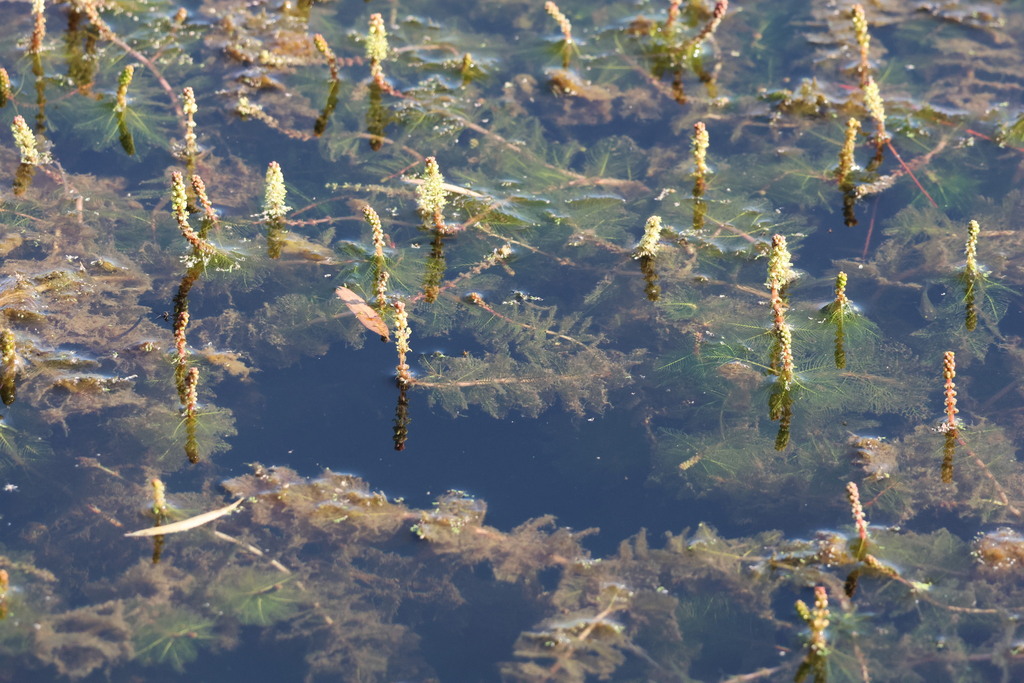
© abcdefgewing via iNaturalist.org, used under CC-BY-NC
Introduction and Spread
Eurasian water-milfoil, also known as the “zombie plant”, likely arrived in North America through the aquarium trade, or in ballast water from shipping in the 1940s. The first record in Canada was from Lake Erie in 1961 (Aiken et al. 1979). Since then, it has become one of the most widespread and problematic aquatic invasive species in North America due to its competitive growth habits and ability to spread vegetatively by rhizome fragments (MNR 2021). These fragments can break easily, allowing Eurasian water-milfoil to be transported long distances by boats, boat trailers, fishing gear, and other aquatic equipment (NYIS 2025; Smith and Barko 1990). It can also spread naturally by water currents, wind and waterfowl, as well as seasonal autofragmentation (Aiken et al. 1979). It is able to rapidly colonize areas that have experienced some form of disturbance, which can further promote fragmentation and spread.
Eurasian water-milfoil is native to Eurasia and North Africa. Outside of its native range, it has spread across every continent except Antarctica (MNR 2021). In North America, it is present throughout most of the United States, all of the the Great Lakes as well as in-land lakes in southern and eastern Ontario (MNR 2021; EDDMaPs 2025). It can be found in six Canadian provinces including Quebec, New Brunswick, Prince Edward Island, Manitoba and British Columbia (NCC 2025, iNaturalist 2025). It is a provincially regulated species in Alberta, British Columbia, and Ontario.
Habitat
Eurasian water-milfoil is most commonly found in slow or stagnant waters, such as ponds, marshes, lakes with little disturbance, or along sheltered portions of streams (i.e., coves, inlets). It is able to rapidly colonize areas that have experienced some form of disturbance. It is most common in depths of 1 – 3 m but can grow up to depths of up to 10 m; growth is limited in very shallow waters due to fluctuating temperature and water levels. The plant’s rooting depth and growth form vary with water depth and clarity—shallow, turbid waters promote horizontal, matted growth near the surface, while in deeper, clearer waters, it forms long strands that do not reach the surface or form dense canopy stands. Well-adapted to a range of conditions, Eurasian water-milfoil thrives in both nutrient-rich and nutrient-poor environments, tolerates a broad pH range (5.4–11), and grows best in alkaline waters and temperatures between 15–35°C (Smith and Barko 1990).
Identification
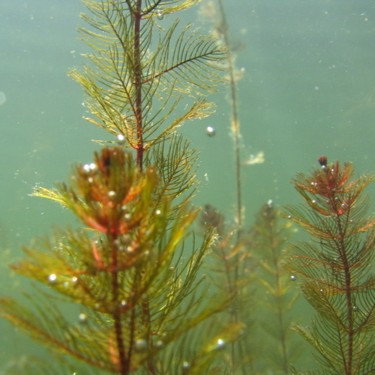
Eurasian water-milfoil leaves
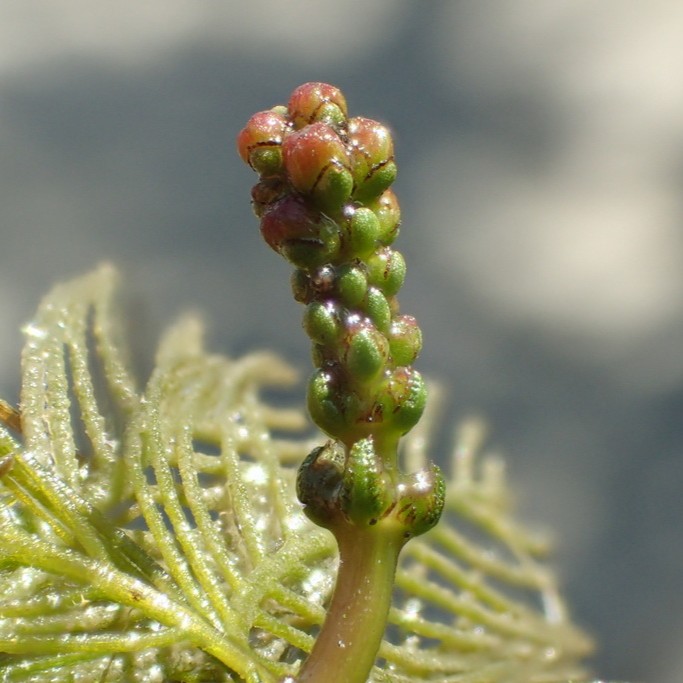
Eurasian water-milfoil fruit
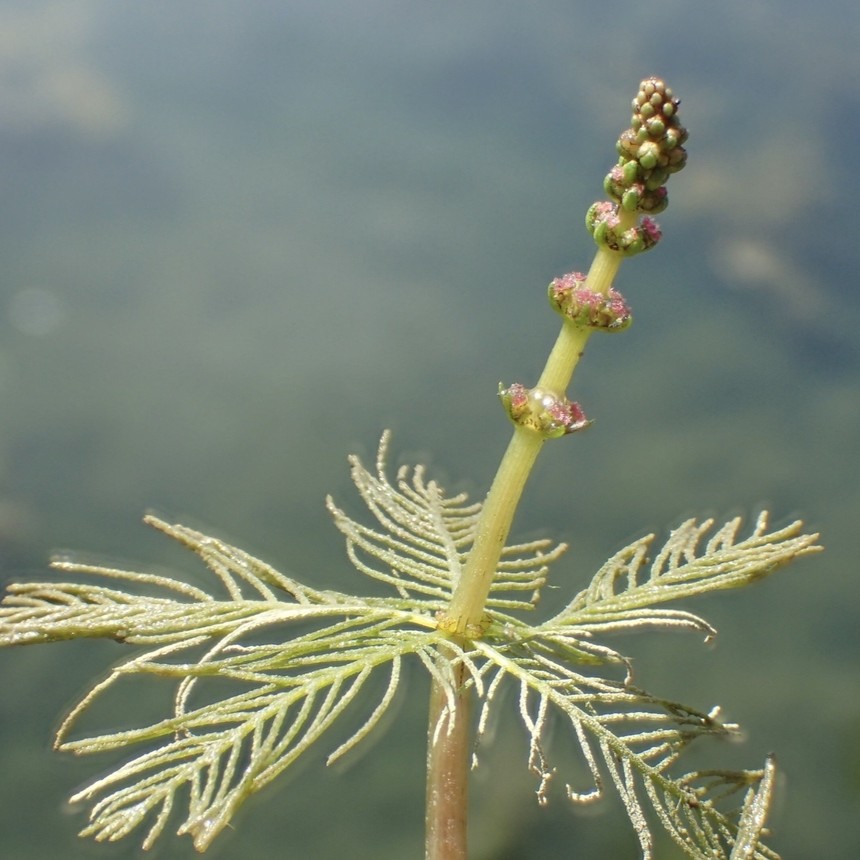
Eurasian water-milfoil stem
Impacts
Life cycle
Eurasian water-milfoil can spread sexually by seed as well as vegetatively through stem fragmentation and stolon growth. In the Great Lakes region, Eurasian water-milfoil begins to break dormancy in early spring before other native macrophytes and initiates growth as water temperatures approach 15°C (Smith and Barko 1990). Flowering spikes emerge above the water line once the plant has reached the surface, typically June to July. Fruits develop later in July or August and continue until September. The plant reaches its peak growth and biomass shortly after flowering, when milfoil stems begin to branch and form dense clusters, blocking available sunlight to other submerged plants. Soon after this peak biomass in late summer to early fall the plant begins a natural process called autofragmentation, whereby small branches begin to develop roots, break away from the parent plant, and float until they lose buoyancy, at which point they sink and root in the sediment, ultimately forming new plants. Towards the end of the growing season, some plants die back to their root crowns, while others overwinter intact in an evergreen form. Reserves are stored in overwintering roots and shoots (Aiken et al., 1979).
What You Can Do
You can help prevent the spread of Eurasian water-milfoil by:
Other Resources
- Aiken, S. G., Newroth, P. R., and Wile, I. 1979. The biology of Canadian Weeds.: 34. Myriophyllum spicatum L. Canadian Journal of Plant Science, 59(1), 201-215.
- Borrowman KR, Sager EP, and Thum RA. 2014. Distribution of biotypes and hybrids of Myriophyllum spicatum and associated Euhrychiopsis lecontei in lakes of Central Ontario, Canada. Lake and Reservoir Management. 30: 94-104.
- Cooper AL, DeBues MJ, and Sager EP. 2017. Eurasian watermilfoil management on Big Cedar Lake, Ontario: Progress Report. Pp 1-19.
- EDDMapS. 2025. Eurasian watermilfoil (Myriophyllum spicatum L.). [Accessed 2025 June 18] https://www.eddmaps.org/project/midwest/distribution/viewmap.cfm?sub=3055.
- Extension Lakes, EWM Hand Removal. 2013. https://www.youtube.com/watch?v=CfsEDyAwQP4 [Accessed 2025 June 21].
- FLCA. Farlain Lake Community Association. 2025. Eurasian watermilfoil – dealing with the threat. https://farlainlake.ca/our-lake/eurasian-watermilfoil [Accessed 2025 June 21].
- iNaturalist. Eurasian Water-Milfoil. 2025. [Accessed 2025 June 18] https://www.inaturalist.org/observations?taxon_id=78157.
- Madsen J., Sutherland J., Bloomfield J., Eichler L., Boylen C. 1991. The decline of native vegetation under dense eurasian watermilfoil canopies. Journal of Aquatic Plant Management. 29: 94-99.
- Menninger, H. 2011. Review of the science and management of Eurasian watermilfoil: recommendations for future action in New York state. New York Invasive Species Research Institute. http://fingerlakesinvasives.org/ wp-content/uploads/2014/03/NYISRI-EWM-Report_Final_11Nov2011.pdf, accessed 5 February 2020.
- MNR. Ministry of Natural Resources. 2021. Eurasian water milfoil. [Accessed 2025 June 10] https://www.ontario.ca/page/eurasian-water-milfoil.
- NCC. Nature Conservancy of Canada. 2025. Eurasian milfoil. [Accessed 2025 June 10] https://www.natureconservancy.ca/en/what-we-do/resource-centre/invasive-species/eurasian-milfoil.html.
- Newman, R.M. 2004. Invited review: biological control of Eurasian watermilfoil by aquatic insects: basic insights from an applied problem. Archive for Hydrobiology 159:145-184.
- NYIS. 2025. New York Invasive Species (IS) Information. Eurasian watermilfoil. [Accessed 2025 June 15] https://nyis.info/species/eurasian-watermilfoil/.
- Olden, J.D. and M. Tamayo. 2014. Incentivizing the public to support invasive species management: Eurasian milfoil reduces lakefront property values. 9: e110458.
- Sesin, V., Dalton, R.I., Boutin, C., Robinson, S.A., Bartlett, A.J. and F.R. Pick. 2018. Macrophytes are highly sensitive to the herbicide diquat dibromide in test systems of varying complexity. Ecotoxicology and Environmental Safety 164: 325-333.
- Smith, C.S. and Barko, J.W. 1990. Ecology of Eurasian watermilfoil. Journal of Aquatic Plant Management. 28(2): 55-64.