Dog-Strangling Vine

Description

Dog-strangling vine (Vincetoxicum rossicum) is an invasive perennial vine native to eastern Europe that was introduced to North America as an ornamental plant in the late 1800s. It grows rapidly in a variety of habitats, forming dense mats that can outcompete native vegetation and alter wildlife habitat. Dog-strangling vine spreads readily by wind-dispersed seeds and root fragments, making established populations difficult to control.
  • Scientific name: Vincetoxicum rossicum  

  • French name: Dompte-venin de Russie 

  • Common name(s): European swallowwort, pale swallowwort 

  • Distribution: Found in Ontario, Quebec, New Brunswick, Nova Scotia and PEI.  

  • Regulatory Status: Dog-strangling vine is not a federally regulated species. However, it is regulated in  Ontario as a restricted species under the Invasive Species Act and noxious weed under the Weed Control Act. 

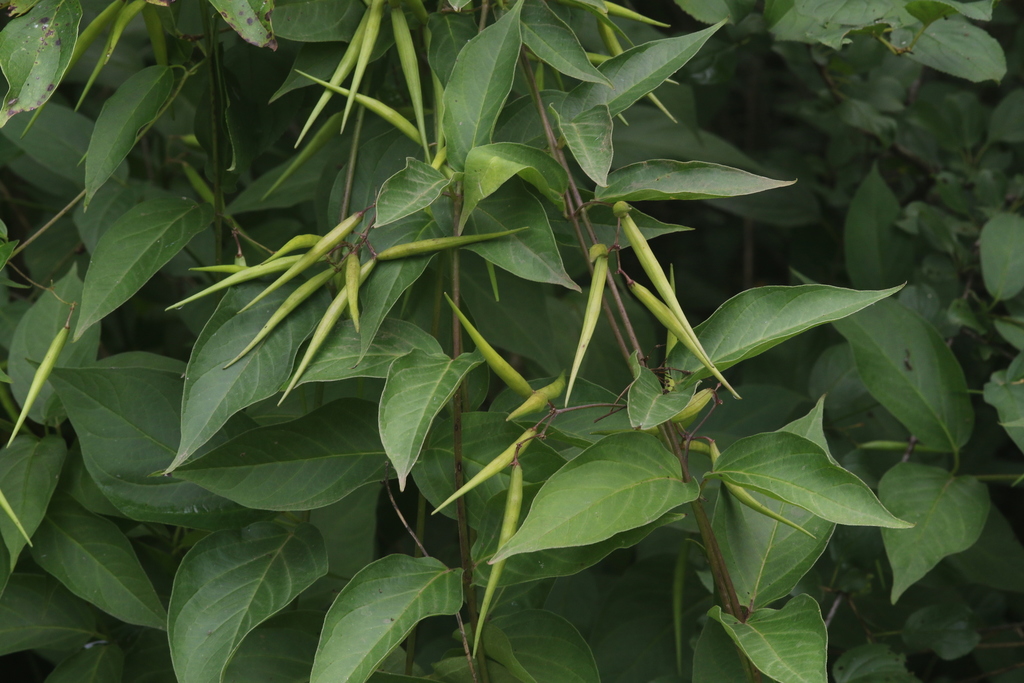
Image of Dog-strangling vine

© Don Sutherland via iNaturalist.org, used under CC-BY-NC

Introduction and Spread

Dog-strangling vine is native to eastern Europe and was introduced to North America as an ornamental plant in the late 1800s. It was first recorded in Canada (Toronto, Ontario) in 1899Dog-strangling vine can spread via seeds and root fragments. It produces a substantial number of seeds. The seeds of dog strangling vine have a tuft of hair (coma) that aids in wind dispersal. Dense populations of dog-strangling vine can produce 30,000 seeds/m2 (Smith 2006) with some plants producing over 100 seed pods (Smith et al. 2006). Seeds have high viability and germination rates, allowing this plant to form a substantial seed bank.

Habitat

Dog-strangling vine can grow in a variety of habitats such as woodland edges, ravines, fence lines, roadsides, prairies, and in forests. It can survive across a wide range of disturbed and urban landscapes (Averill et al. 2010). It prefers open sunny areas but can tolerate light shade. Dog-strangling vine generally has reduced success and reproductive potential in forests, it can invade closed-canopy forests and dominate the understory, particularly where there are gaps in the canopy (Westbrook et al. 2023)

Identification

  • Height and Stem: Dog-strangling vine is a herbaceous perennial plant. It has a woody rootstalk and can grow between 0.6 m – 1.2 m tall or more. Its stems are covered in fine hairs. They can twine or climb. The stems can also twine around themselves forming dense mats of interwoven vegetation.  

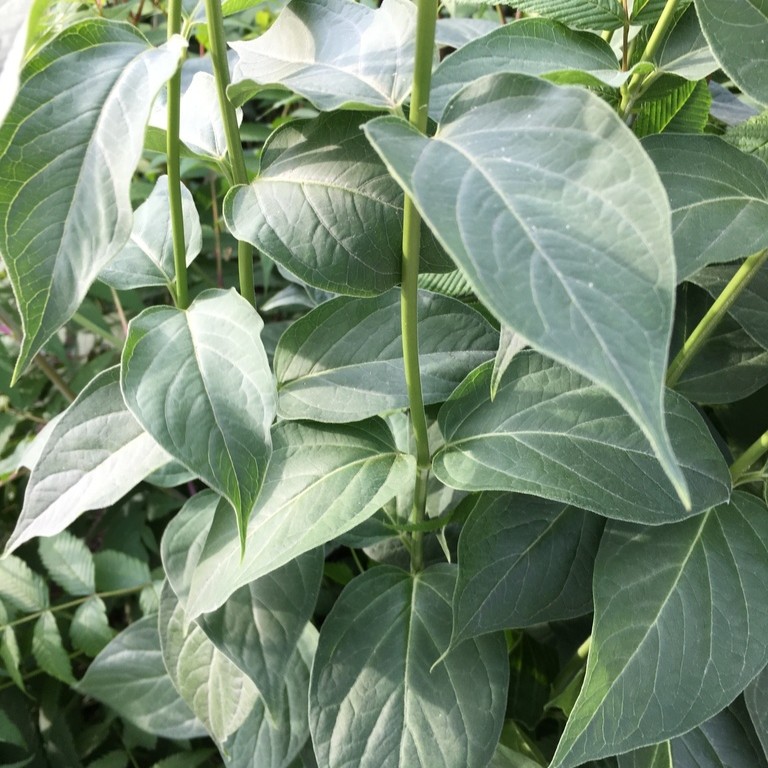
  • Leaves: The leaves of dog-strangling vine occur opposite and are hairless with smooth or slightly wavy margins. They can range in colour from light green to dark green and are oval to oblong, rounded at the base and pointed at the tip.  

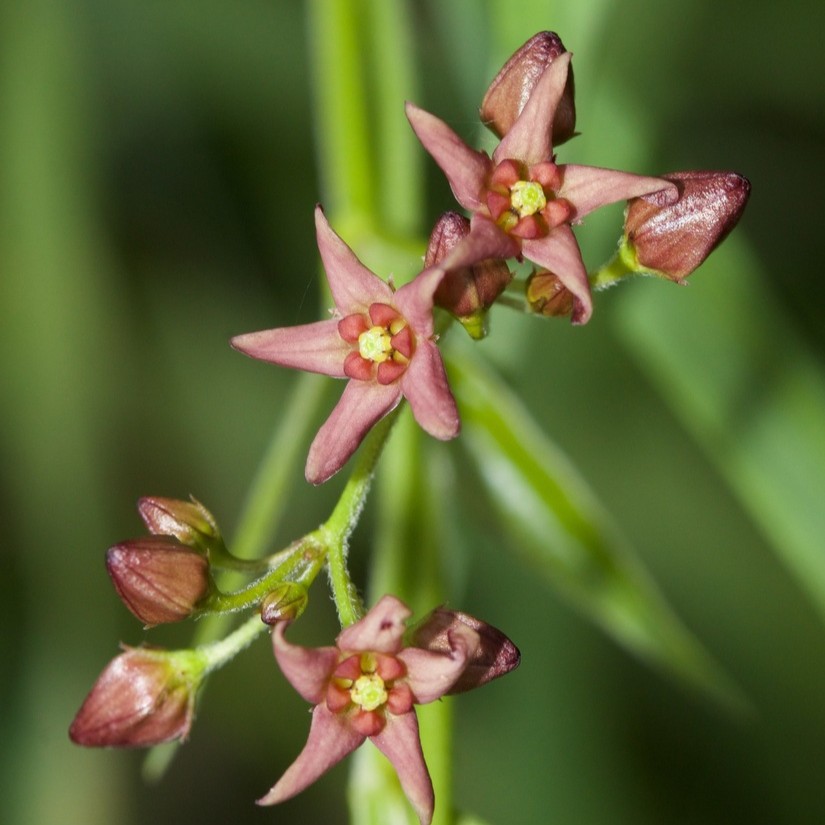
  • Flowers: The flowers of dog-strangling vine emerge from the leaf axils in clusters of 5 – 20 flowers. They have five petals and are red-brown or maroon to pinkish.  

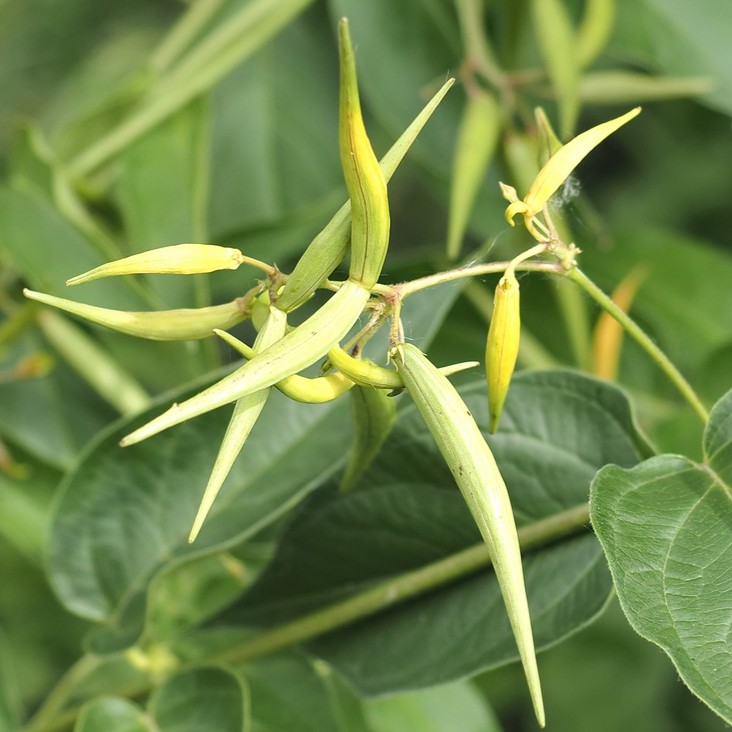
  • Fruits: The fruits of dog-strangling vine are slender seed pods called follicles. There are two follicles at each leaf axils. They measure 4 cm – 7 cm long. They contain a milky sap, turn green to brown and similar to other members of the milkweed family, have seeds with a tuff of hair (called coma) that aids in wind dispersal.  

  • Roots: Dog strangling vine has a woody rootstalkNew plants can grow from small root fragments.  

Image of Dog-strangling vine flowers

Dog-strangling vine flower

Image of Dog-strangling vine leaves

Dog-strangling vine leaves

Image of Dog-strangling vine fruit

Dog-strangling vine fruit

Impacts

  • Dog-strangling vine form monoculture stands that out-compete native plants for resources such as light, water and soil nutrients. The stands create heavy shade (Westbrook et al. 2023) 

  • Dog-strangling vine produces chemicals from its roots that prevent the growth of nearby plants. This alters plant community composition and soil microbiota. It can displace species at risk plants (Bugiel et al. 2018).  

  • By displacing native plants, dog-strangling vine can negatively impact wildlife by altering habitat. For example, it has reduced habitat for grassland birds such as the bobolink (Dolichonyx oryzivorus).  

  • Dog-strangling vine can impact natural forest regeneration. It competes with young trees for resources and can weigh them down. The dense interwoven mats of this plant can make forests more difficult to access and can impede forestry operations 

  • Dog-strangling vine impacts the Monarch butterfly (Danaus plexippus) which is a species at risk in Canada with an Endangered status. Butterflies mistakenly lay their eggs on dog-strangling vine instead of native milkweed species which are their true host plants. The larvae are unable to complete their life cycle on dog-strangling vine because it does not provide the necessary food source. This has led to declines in Monarch butterfly populations (COSEWIC 2016).  

  • Dog-strangling vine has a compound called vincetoxin which renders it toxic to humans and other mammals.  

What You Can Do

You can help prevent the spread of Dog-strangling vine by:

  • PlayCleanGoTo prevent the spread of invasive species, stay on designated trails to prevent spreading, clean equipment, vehicles and clothing after visiting infested areas, and dispose of plant material properly. Cleaning equipment and vehicles that have come into contact with dog-strangling vine, and educating the public about the importance of not moving plant materials, can help prevent the spread to new areas. 

  • Spread Awareness: Spread awareness about the ecological risks posed by invasive dog-strangling vine and encourage responsible practices in your community. 

  • ReportingReport dog-strangling vine and any invasive species to the appropriate provincial authorities such as provincial invasive species councils or report using free tools such as EDDMapS and iNaturalist. 

  1. Averill K, DiTomasso A, Mohler C and Milbrath L. 2010. Establishment of the invasive perennial Vincetoxicum rossicum across a disturbance gradient in New York State, USA. 211: 65 – 77.  
  2. Biazzo J and Milbrath L. 2019. Response of pale swallowwort (Vincetoxicum rossicum) to multiple years of mowing. Invasive Plant Science and Management. 12(3): 169 – 175.  
  3. Bugiel L, Livingstone S, Isaac M, Fulthorpe R and Martin A. 2018. Impacts of invasive plant species on soil biodiversity: a case study of dog-strangling vine (Vincetoxicum rossicum) in a Canadian National Park. Canadian Journal of Botany. 98(4): 716 – 723.  
  4. COSEWIC. 2016. COSEWIC assessment and status report on the Monarch Danaus plexippus in Canada. Committee on the Status of Endangered Wildlife in Canada. Ottawa. xiii + 59 pp. Available from: https://www.canada.ca/en/environment-climate-change/services/species-risk-public-registry/cosewic-assessments-status-reports/monarch-2016.html 
  5. DiTomasso A, Stokes C, Cordeau S, Milbrath L and Whitlow T. 2018. Seed-dispersal ability of the invasive perennial vines Vincetoxicum nigrum and Vincetoxicum rossicum. Invasive Plant Science and Management. 11(1): 10 – 19.  
  6. McKague C and Cappuccino N. 2005. Response of pale swallow-wort, Vincetoxicum rossicum, following aboveground tissue loss: Implications for the timing of mechanical control. The Canadian Field Naturalist. 119(4): 525 – 531.  
  7. Smith L, DiTomasso A and Greipsson S. 2006. Growth and reproductive potential of the invasive exotic vine Vincetoxicum rossicum in northern New York State. Canadian Journal of Botany. 84(12): 1771 – 1780.  
  8. Westbrook A, Millbrath L, Weinberg J and DiTommaso A. 2023. Biology of Invasive Plants 3. Vincetoxicum nigrum (L.) Moench and Vincetoxicum rossicum (Kleopow) Barbarich. Invasive Plant Science and Management. 16(1): 3 – 26.  

Invasive Species Categories

Stop The Spread: Report Invasive Species

How to Prevent and Manage Invasive Species

The Impact of Invasive Species on Canada’s Ecosystems and Economy

Invasive Species Resources: Guides, Manuals, and Best Practices