
Common Buckthorn
Description
Common buckthorn (Rhamnus cathartica) is an invasive shrub or small tree native to Europe and northwestern Asia that was introduced to North America in the 1800s as an ornamental and windbreak plant. It thrives in a variety of habitats and can form dense thickets that crowd out native vegetation and prevent the natural regeneration of forests. Common buckthorn can also alter soil conditions, making invaded areas more favourable to other invasive plants.
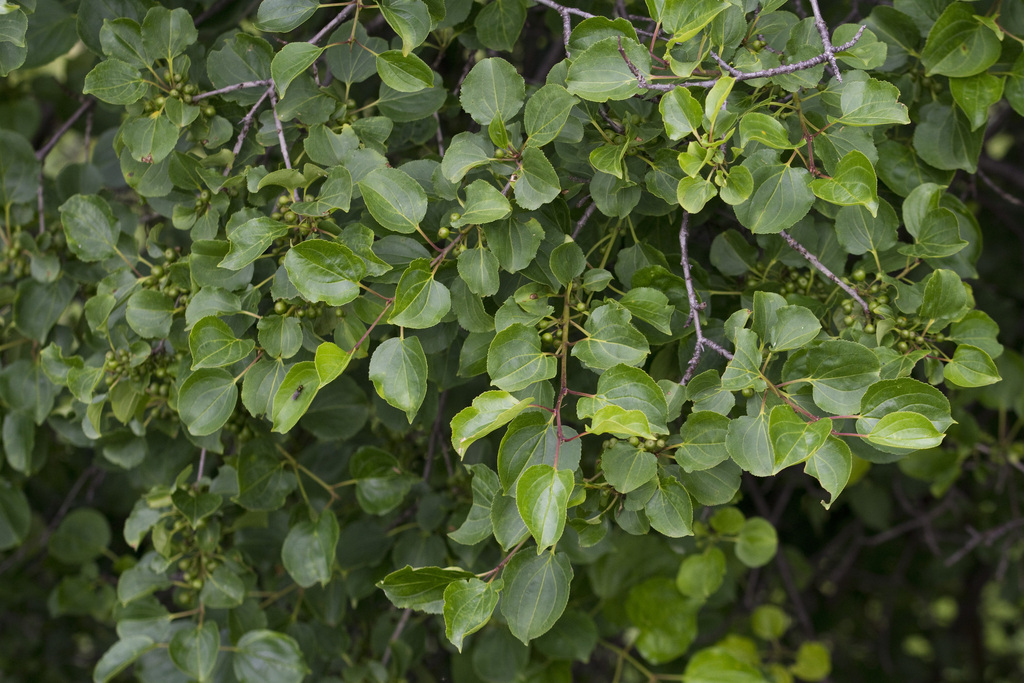
© Martin A. Prinz via iNaturalist.org, used under CC-BY-NC
Introduction and Spread
Common buckthorn is native to Europe and north-western parts of Asia. It was introduced to North America in the 1800s as an ornamental and windbreak plant in agricultural fields. It has also been used for erosion control and streambank stabilization. It became widespread in the 1900s.
In North America, common buckthorn has a widespread distribution and in the USA is found in 40 states. In Canada, common buckthorn is found in all provinces with the exception of Newfoundland and Labrador. It is found as far west as Saskatchewan and as far east as Nova Scotia. It is most abundant in Ontario occurring on both the east and west of the Canadian Shield in southern Ontario and in Québec.
Habitat
Buckthorn can be found in a variety of habitats such as roadsides, woodland edges, pastures, abandoned fields, and riparian areas. It can infiltrate openings in the forest canopy. It can tolerate both dry and moist habitats with a preference for soils with neutral to alkaline pH. It can grow in sunny or partly shaded areas but is limited by deep shade (Kurylo et al. 2007).
Identification
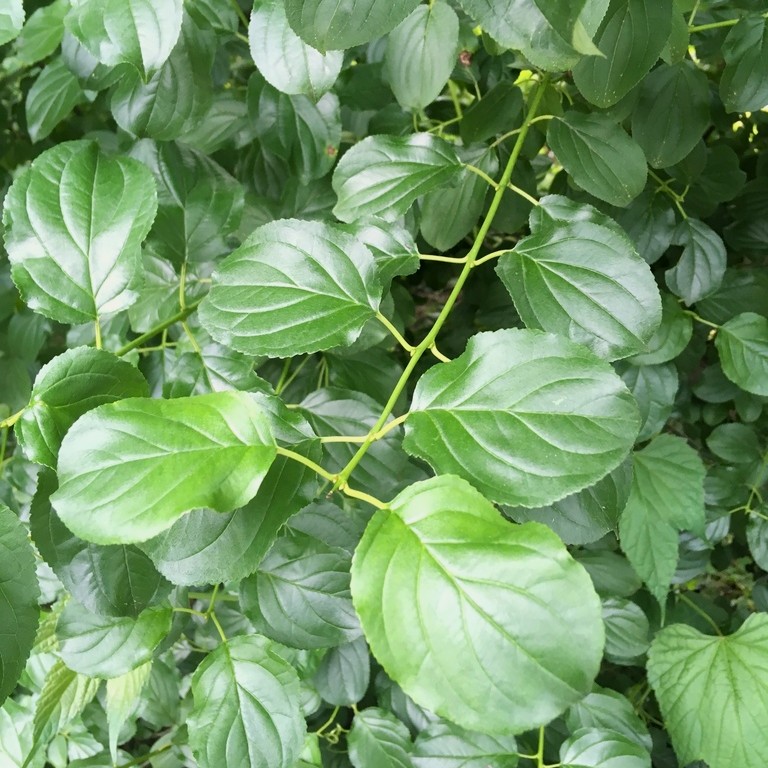
Common buckthorn leaves
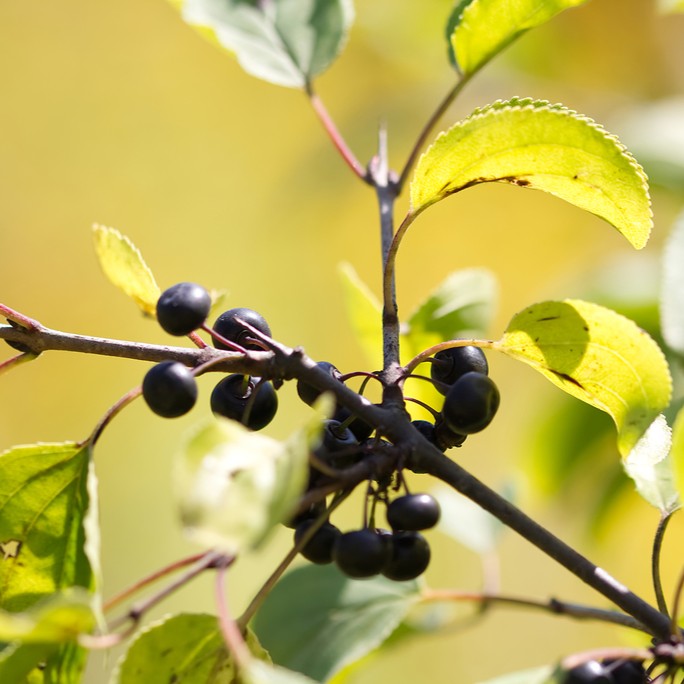
Common buckthorn fruit
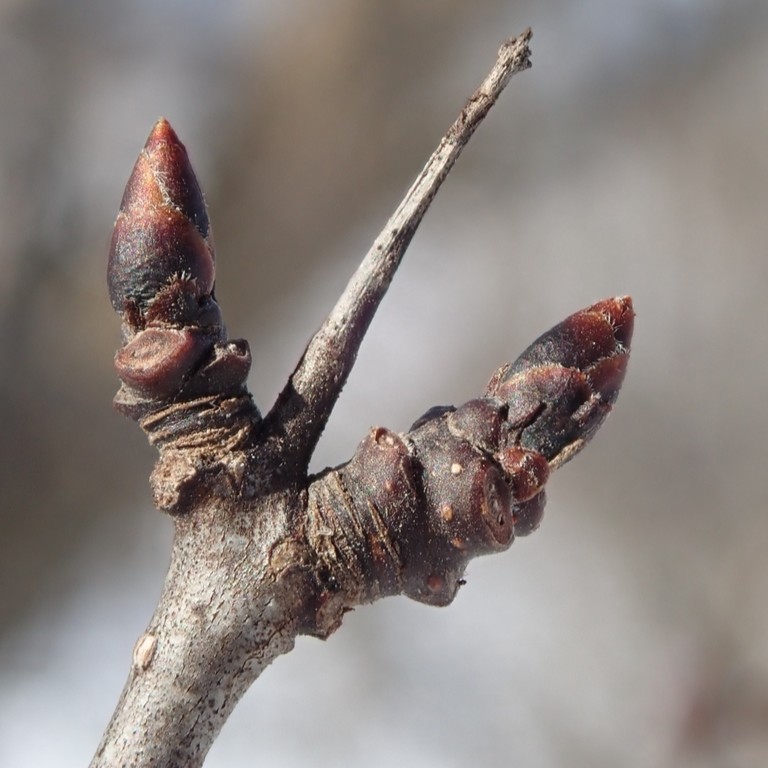
Common buckthorn twig
Impacts
Life cycle
Common buckthorn is one of the first trees to leaf out in the early spring and retains its leaves well into the fall. This gives it a longer growing season compared to other species. In the spring, it allows the plant to start photosynthesis early and get a head start on growing when other shrubs or trees are still leafless. Common buckthorn flowers in the early spring (April – May). Only female trees will produce fruits from July to August. Fruits can remain attached to the plant well into the winter.
What You Can Do
You can help prevent the spread of common buckthorn by:
Other Resources
- Heneghan L, Fatemi F, Umek L, Grady K, Fagen K, and Workman M. 2006. The invasive shrub European buckthorn (Rhamnus cathartica L.) alters soil properties in Midwestern US woodlands. Applied Soil Ecology 32(1):142–148.
- Knight, K.S., Kurylo, J.S., Endress A.G., Stewart J.R., and Reich P.B. 2007. Ecology and ecosystem impacts of common buckthorn (Rhamnus cathartica): A review. Biological Invasions 9:925-937.
- Kurylo, J.S., Knight K.S., Stewart J.R., and Endress, A.G. 2007. Rhamnus cathartica: Native and naturalized distribution and habitat preferences. Journal of the Torrey Botanical Society 134(3): 420-430.