
Box Tree Moth
Description
The Box Tree Moth, native to East Asia, has become a significant pest in Europe and has recently been detected in North America. Primarily affecting boxwood plants (Buxus spp.), it poses no direct threat to human or animal health but has severe implications for the nursery trade and urban landscapes due to the damage it causes to these ornamental plants.
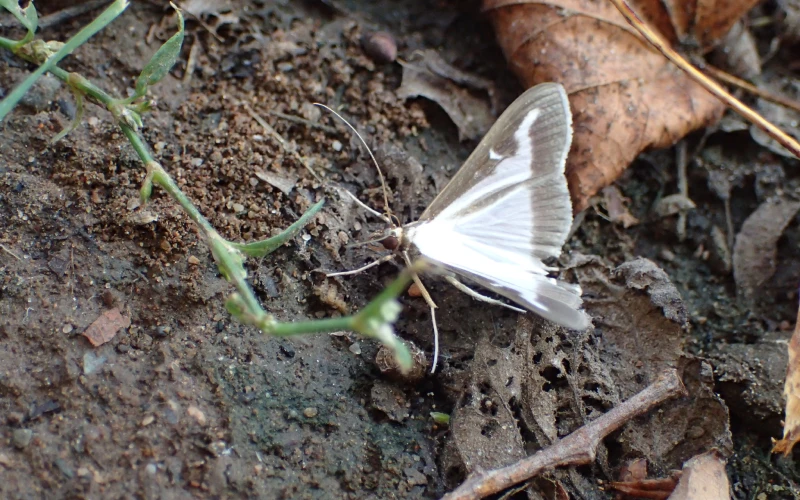
© Lara Gibson, some rights reserved (CC BY)
Introduction and Spread
Box Tree Moth spreads primarily through the movement of infested boxwood plants. It can spread easily across regions, being able to fly distances of 5-10 km per year. Originally detected in Germany and the Netherlands around 2006, it is believed to have been introduced with shipments of Buxus plants from Asia.
Distribution
In Canada, the Box Tree Moth is established in Ontario, in the regions between Toronto and Windsor, and Toronto and Niagara. Recent detections have also been confirmed in Quebec, Nova Scotia, and New Brunswick. It is considered a regulated pest within these provinces.
Habitat
The moth is exclusively found on boxwood shrubs, utilized extensively in landscapes for hedging and ornamental purposes. These plants provide the necessary environment for the moth’s lifecycle and spread and are themselves not native to Canada.
Identifying Features / Life Stages of the Box Tree Moth:
Impacts
The moth causes significant defoliation of boxwood plants, leading to aesthetic damage and potential plant death. This not only impacts biodiversity but also the horticulture industry due to the control and replacement costs.
What You Can Do:
PlantWise: Choose native plants for your yard and gardens. You can use our Grow Me Instead guides to find native alternatives.
1. Seehausen, M Lukas et al. “Modelling potential distribution of the invasive box tree moth across Asia, Europe, and North America.” PloS one vol. 19,4 e0302259. 26 Apr. 2024, doi:10.1371/journal.pone.0302259