
Periwinkle
Description
Periwinkle (Vinca minor and Vinca major) is an invasive evergreen groundcover native to Eurasia, the Mediterranean region, and northern Africa that was introduced to North America in the 1700s as an ornamental plant. Still commonly planted in gardens, periwinkle can escape into natural areas where its extensive network of runners allows it to spread rapidly and form dense mats. These mats can crowd out native vegetation, reduce tree seedling survival, and dominate the understory of forests and other shaded habitats.
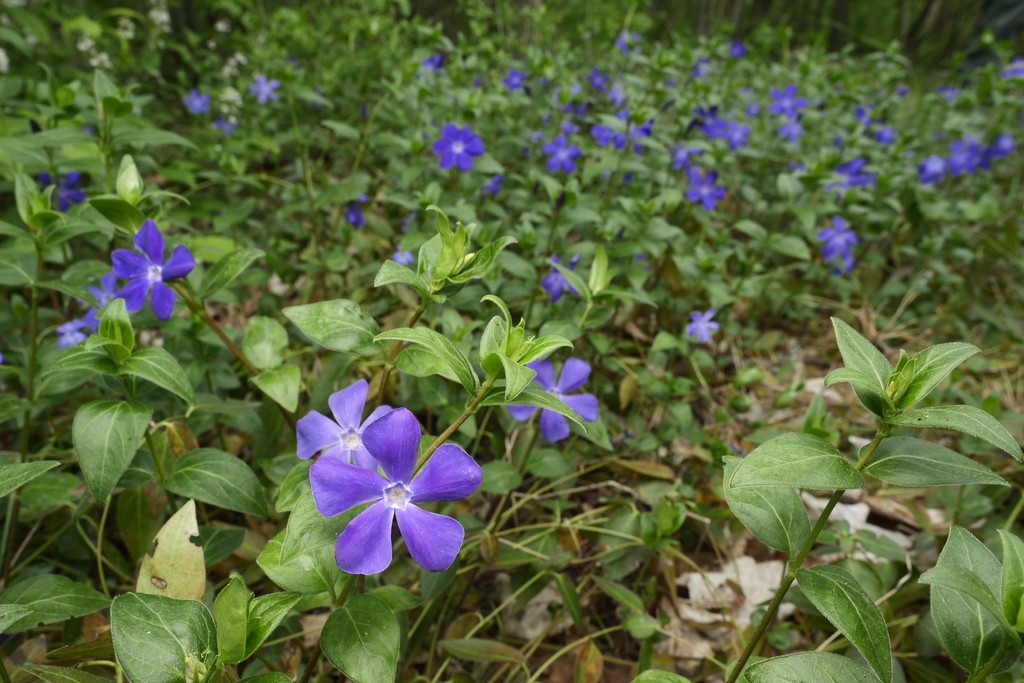
© Alexis Tinker-Tsavalas via iNaturalist.org, used under CC-BY
Introduction and Spread
Periwinkle is native to Eurasia, the Mediterranean and northern Africa (V. major) and was introduced to North America in the 1700s as a fast-growing ground cover (Wells and Brown 2000; Darcy and Burkart 2002; DiTomaso et al. 2013). The exact introduction date to Canada is uncertain, however, it is suggested that it was present around this time period. Most infestations of periwinkle originate from the intentional planting of this species in gardens and/or the improper disposal of garden waste into natural areas. Periwinkle spreads predominantly through its above and below ground runners that can root at the node (where the leaf attaches). Periwinkle is commonly available in plant nurseries across Canada. To date, there are over 30 cultivars of periwinkle available in the horticulture industry.
Lesser periwinkle is the more abundant of the two species found in Canada. In the USA, it occurs in 44 states. In Canada it is found in British Columbia, Ontario, Québec, New Brunswick and Prince Edward Island (EDDMapS 2025a; iNaturalist 2025a). In the USA, greater periwinkle is found in 44 states and has a limited distribution in Canada being found in isolated populations in British Columbia, Québec and Ontario (EDDMapS 2025b; iNaturalist 2025b).
Habitat
Periwinkle is commonly planted in gardens as a fast-growing groundcover. From intentional planting in addition to improper disposal of garden waster, periwinkle can spread into disturbed areas such as along roadsides or trails, but can also spread into natural areas such as dense canopy forests due to its shade tolerance (Stone 2009). While it can tolerate a wide range of environmental conditions, it prefers shade or partial shade and moist soils with good drainage.
Identification
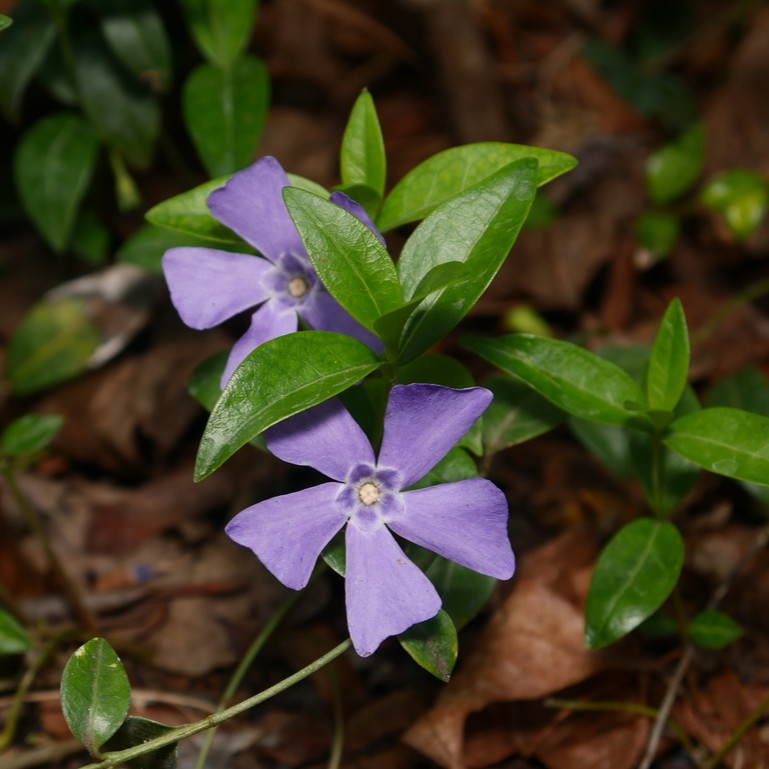
Lesser periwinkle
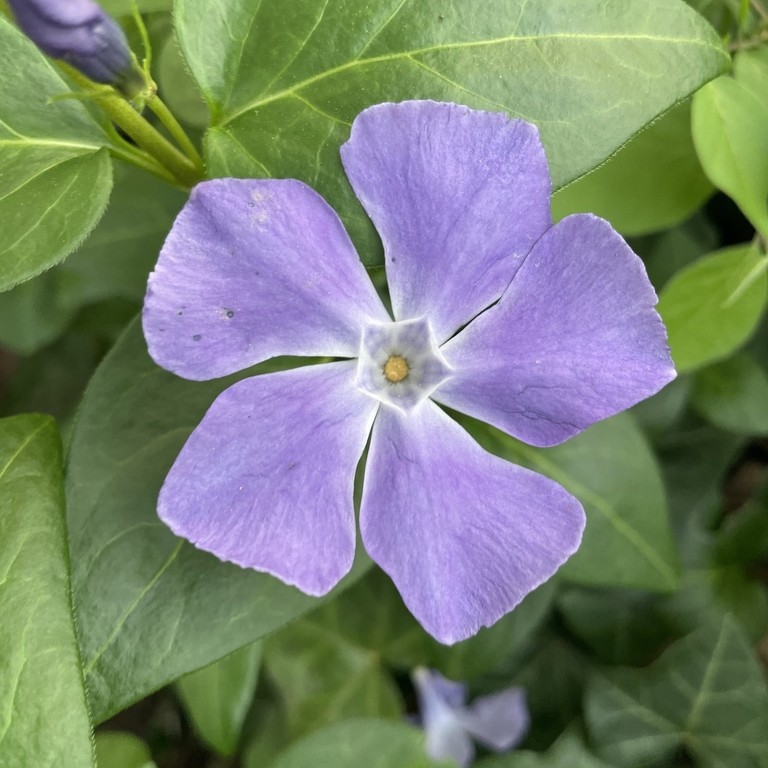
Greater periwinkle flower
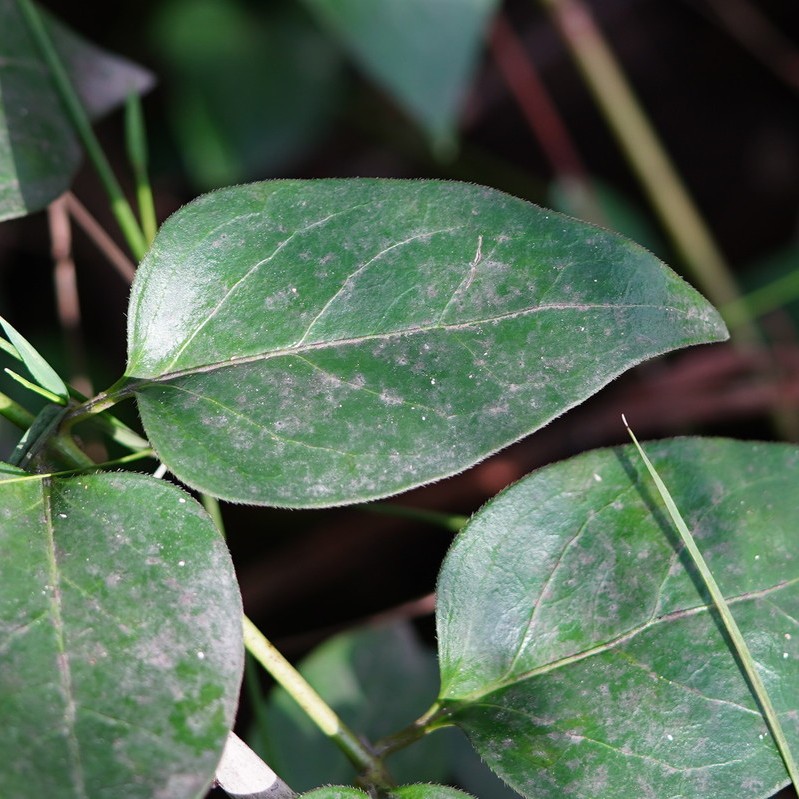
Greater periwinkle leaves
Impacts
Life cycle
Periwinkle stays green all-year round. Its leaves will often remain green under the snow. It flowers in April to May and into midsummer, with occasional flowers produced in the fall. They are pollinated by butterflies, bees, flies and beetles. Fruits are rarely produced as this plant spreads predominantly via vegetative growth (above and below ground runners).
What You Can Do
You can help prevent the spread of periwinkle by:
Other Resources
- CABI. 2019. Vinca major (Big periwinkle). CABI Compendium. Available from: https://www.cabidigitallibrary.org/doi/10.1079/cabicompendium.56402 [Accessed 2025 July 23].
- Darcy A and Burkart M. 2002. Allelopathic Potential of Vinca minor, an Invasive Exotic Plant in West Michigan Forest. BIOS. 73: 127 – 132.
- Derickx L and Antunes P. 2013. Periwinkle (Vinca minor). In A Guide to the Identification and Control of Exotic Invasive Species in Ontario's Hardwood Forests. Algoma University. pp. 143-154. Available from: https://www.researchgate.net/publication/258633371_A_Guide_to_the_Identification_and_Control_of_Exotic_Invasive_Species_in_Ontario's_Hardwood_Forests.
- DiTomaso J, Kyser G et al. 2013. A Weed Report – Vinca major L. (Big periwinkle). Available from: https://wric.ucdavis.edu/information/crop/natural%20areas/wr_V/Vinca.pdf [Accessed 2025 July 23].
- EDDMapS. 2025a. Common periwinkle (Vinca minor L.). Available from: https://www.eddmaps.org/distribution/usstate.cfm?sub=3081 [Accessed 2025 July 23].
- EDDMapS. 2025b. Big periwinkle (Vinca major L.). Available from: https://www.eddmaps.org/distribution/usstate.cfm?sub=4528 [Accessed 2025 July 23].
- iNaturalist. 2025a. Lesser periwinkle (Vinca minor). Available from: https://www.inaturalist.org/observations?place_id=6712&subview=map&taxon_id=55844 [Accessed 2025 July 23].
- iNaturalist. 2025b. Greater periwinkle (Vinca major). Available from: https://www.inaturalist.org/observations?place_id=6712&subview=map&taxon_id=53326 [Accessed 2025 July 23].
- Kahri K. 2004. The Role of Leaf Out Timing and Vinca minor Invasion on a Deciduous Understory Plant Community [Master's thesis, The University of Guelph].
- Panasenko N and Anishchenko L. 2018. Influence of Invasive Plants Parthenocissus vitacea and Vinca minor on Biodiversity Indices of Forest Communities. Contemporary Problems of Ecology. 11: 614 – 623.
- Stone K. 2009. Vinca major, V. minor. In: Fire Effects Information System. Available from: https://www.fs.usda.gov/database/feis/plants/vine/vinspp/all.html [Accessed 2025 July 23].