Common Buckthorn

Description

Common buckthorn (Rhamnus cathartica) is an invasive shrub or small tree native to Europe and northwestern Asia that was introduced to North America in the 1800s as an ornamental and windbreak plant. It thrives in a variety of habitats and can form dense thickets that crowd out native vegetation and prevent the natural regeneration of forests. Common buckthorn can also alter soil conditions, making invaded areas more favourable to other invasive plants.
  • Scientific name: Rhamnus cathartica 

  • French name: Nerprun cathartique

  • Common name(s): European buckthorn or purging buckthorn

  • Regulatory Status: Buckthorn is regulated under the Plant Protection Regulations (D-01-04) which prohibits the movement of this species as an alternate host to oat crown rust (Puccinia coronata). It is also provincially regulated as a noxious weed in Ontario 

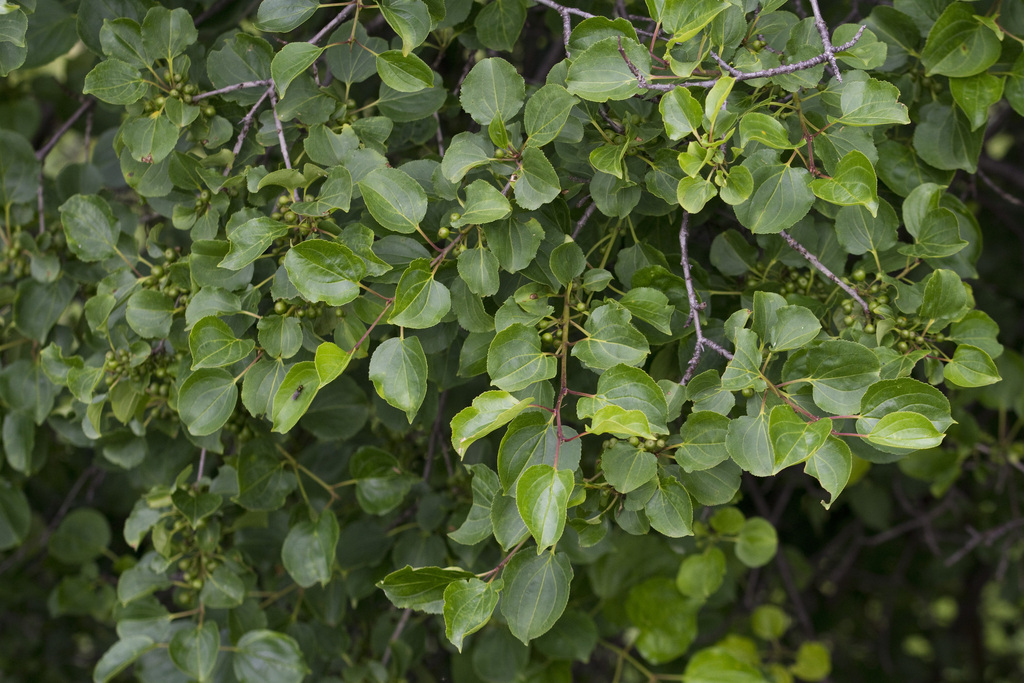
Image of common buckthorn

© Martin A. Prinz via iNaturalist.org, used under CC-BY-NC

Introduction and Spread

Common buckthorn is native to Europe and north-western parts of Asia. It was introduced to North America in the 1800s as an ornamental and windbreak plant in agricultural fieldsIt has also been used for erosion control and streambank stabilization. It became widespread in the 1900s. 

In North America, common buckthorn has a widespread distribution and in the USA is found in 40 states. In Canada, common buckthorn is found in all provinces with the exception of Newfoundland and Labrador. It is found as far west as Saskatchewan and as far east as Nova Scotia. It is most abundant in Ontario occurring on both the east and west of the Canadian Shield in southern Ontario and in Québec.

Habitat

Buckthorn can be found in a variety of habitats such as roadsides, woodland edges, pastures, abandoned fields, and riparian areas. It can infiltrate openings in the forest canopy. It can tolerate both dry and moist habitats with a preference for soils with neutral to alkaline pH. It can grow in sunny or partly shaded areas but is limited by deep shade (Kurylo et al. 2007).

Identification
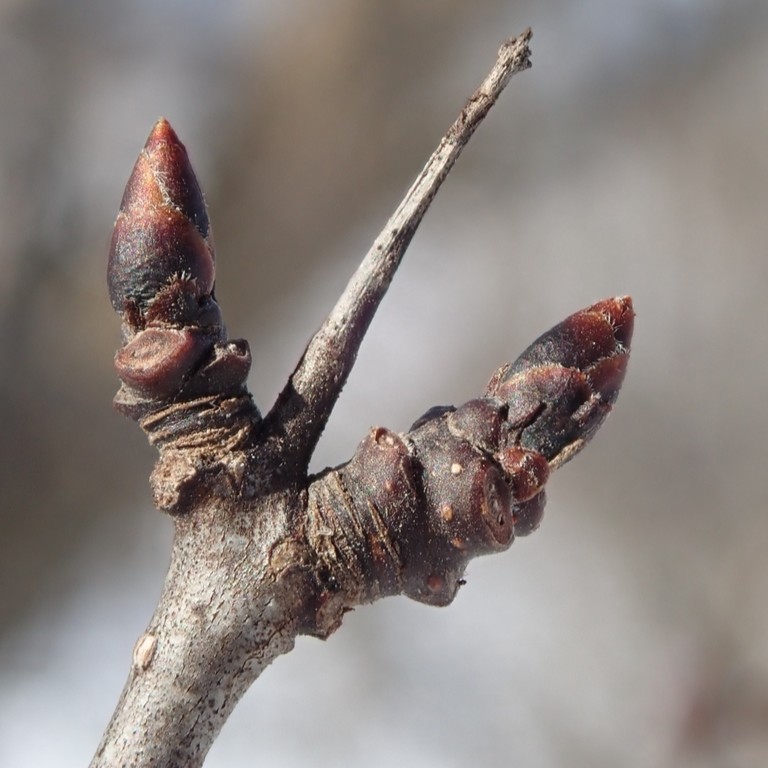
  • Height, Bark, Twigs: A shrub or small trees that grows 6 – 7 m tall. Its bark is dark grey to black with prominent lenticels (lines) similar to birch trees. The bark is smooth and shiny with a metallic sheen when young. The bark becomes a rougher texture when mature. When the bark is scratched or removed, the inner bark (cambium layer) is orange (key ID feature). Its twigs have sharp thorn-like tips, generally located at the end of the twig. Its buds are pointed and hug the stem.  

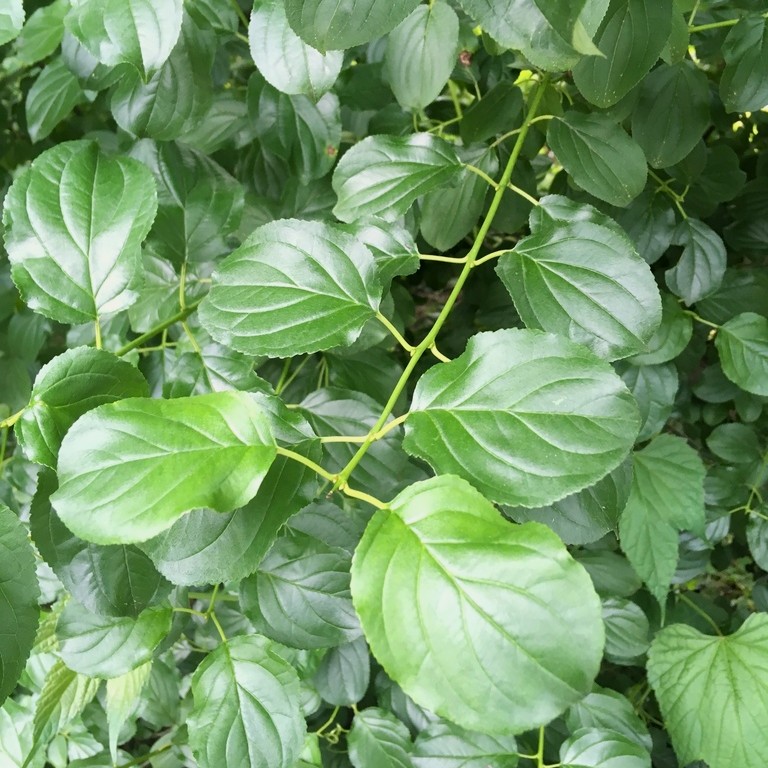
  • Leaves: The leaves are opposite to subopposite, occasionally alternate. They are oval to egg-shaped, curved or folded with a sharp tip and finely toothed margins. The leaves have 3 -5 strongly curved prominent veins per side that arch towards the tip of the leaf. 

  • Flowers: Small, four-petaled, greenish-yellow flowers. They occur in clusters at the leaf axils. 

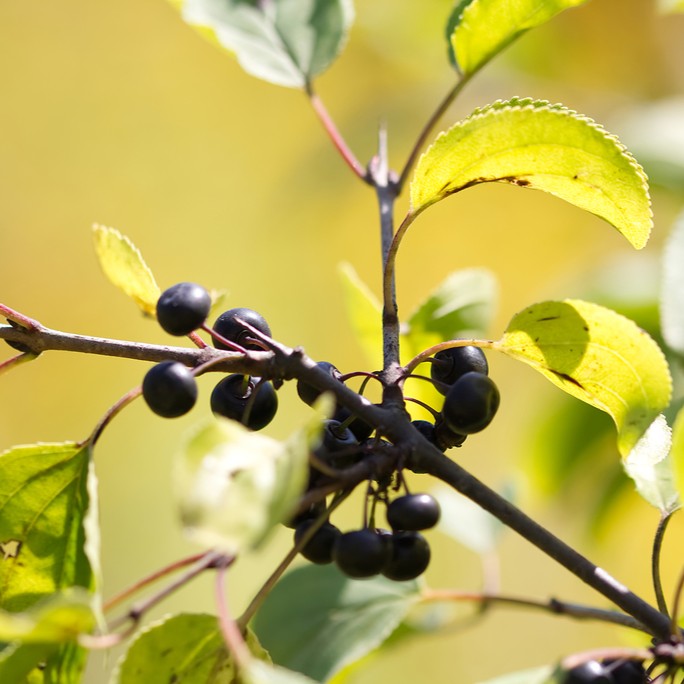
  • Fruits: On female trees, black, berry-like fruits are produced in dense clusters at the leaf axils. They can remain on the play well into the winter. 

  • Roots: Buckthorn has an extensive fibrous root system.  

Image of common buckthorn leaves

Common buckthorn leaves

Image of common buckthorn fruit

Common buckthorn fruit

Image of common buckthorn thorn

Common buckthorn twig

Impacts

  • Common buckthorn alters soil-nitrogen levels which can make it harder for other native species to survive. It also tends to increase the presence of invasive species that thrive in nitrogen-rich soils such as invasive honeysuckles (Lonicera spp.). These changes to the soil can have long-lasting effects even after buckthorn is removed from an area (Heneghan et al. 2006). 

  • Sites invaded by common buckthorn show lower overall plant species richness and a higher concentration of weedy and exotic species (Knight et al. 2007) 

  • The growth of hundreds of buckthorn seedlings on the forest floor prevents other native species from growing. In woodlots, this can prevent natural regeneration (Knight et al. 2007) 

  • Buckthorn berries have a laxative effect on birds. This effect can be so severe that it can cause mortality of smaller bird species. 

  • Common buckthorn is a host to two pests that reduce crop yields: the soybean aphid (Aphis glycines), and the fungus that causes oat crown rust (Puccinia coronata spp. avenae).  

  • It can inhibit recreational activities by making it more difficult to walk along trails where it is established as it grows in very dense thickets.  

Life cycle

Common buckthorn is one of the first trees to leaf out in the early spring and retains its leaves well into the fall. This gives it a longer growing season compared to other species. In the spring, it allows the plant to start photosynthesis early and get a head start on growing when other shrubs or trees are still leafless. Common buckthorn flowers in the early spring (April – May). Only female trees will produce fruits from July to August. Fruits can remain attached to the plant well into the winter. 

What You Can Do

You can help prevent the spread of common buckthorn by:

  • PlayCleanGoTo prevent the spread of invasive species, stay on designated trails to prevent spreading, clean equipment, vehicles and clothing after visiting infested areas, and dispose of plant material properly. Cleaning equipment and vehicles that have come into contact with common buckthorn, and educating the public about the importance of not moving plant materials, can help prevent the spread to new areas. 

  • PlantWiseDo not plant invasive species. Choose native or non-invasive alternatives. Dispose of yard waste properly and do not dump it into natural areas. 

  • Educate: Learn how to identify common buckthorn and spread awareness about the ecological risks posed by invasive common buckthorn and encourage responsible practices in your community. 

  • ReportingReport common buckthorn and any invasive species to the appropriate provincial authorities such as provincial invasive species councils or report using free tools such as EDDMapS and iNaturalist. 

  1. Heneghan L, Fatemi F, Umek L, Grady K, Fagen K, and Workman M. 2006. The invasive shrub European buckthorn (Rhamnus cathartica L.) alters soil properties in Midwestern US woodlands. Applied Soil Ecology 32(1):142–148. 
  2. Knight, K.S., Kurylo, J.S., Endress A.G., Stewart J.R., and Reich P.B. 2007. Ecology and ecosystem impacts of common buckthorn (Rhamnus cathartica): A review. Biological Invasions 9:925-937.  
  3. Kurylo, J.S., Knight K.S., Stewart J.R., and Endress, A.G. 2007. Rhamnus cathartica: Native and naturalized distribution and habitat preferences. Journal of the Torrey Botanical Society 134(3): 420-430.   

Invasive Species Categories

Stop The Spread: Report Invasive Species

How to Prevent and Manage Invasive Species

The Impact of Invasive Species on Canada’s Ecosystems and Economy

Invasive Species Resources: Guides, Manuals, and Best Practices